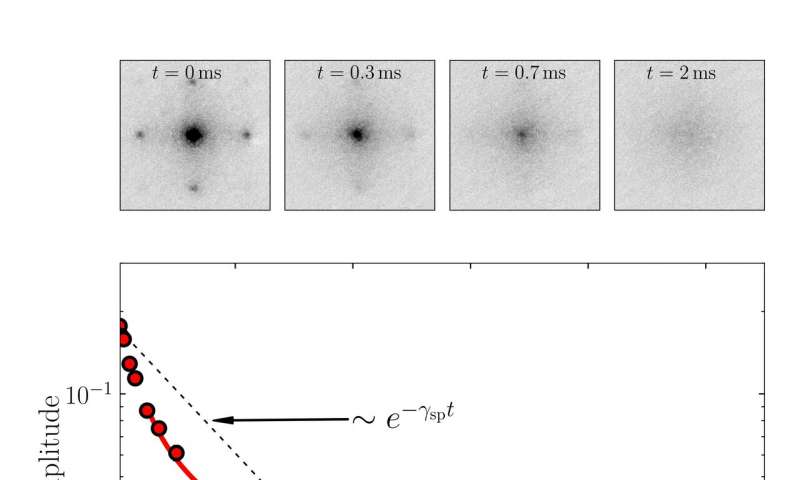
In quantum physics, some of the most interesting effects are the result of interferences. Decoherence, or loss of coherence, occurs when a quantum system eventually loses the ability to produce interferences, due to external noise or coupling to a larger and...
Physics
Testing Hawking radiation in laboratory black hole analogues
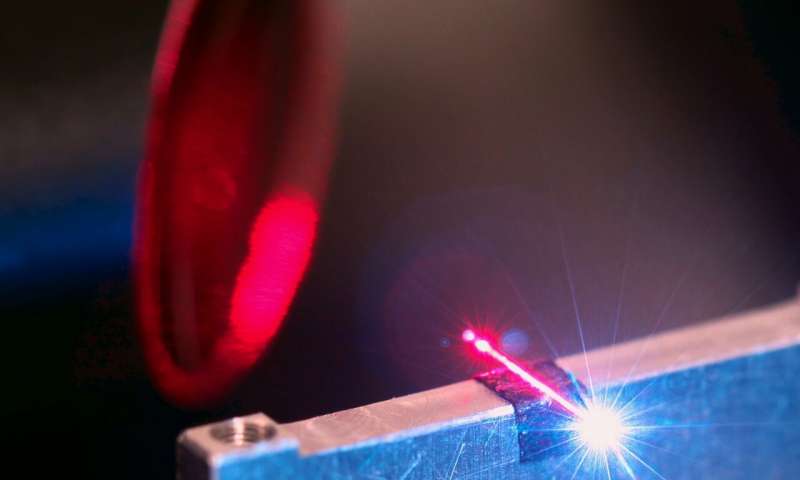
Researchers at Weizmann Institute of Science and Cinvestav recently carried out a study testing the theory of Hawking radiation on laboratory analogues of black holes. In their experiments, they used light pulses in nonlinear fiber optics to establish artificial event...
The defect-free assembly of 2-D clusters with over 100 single-atom quantum systems
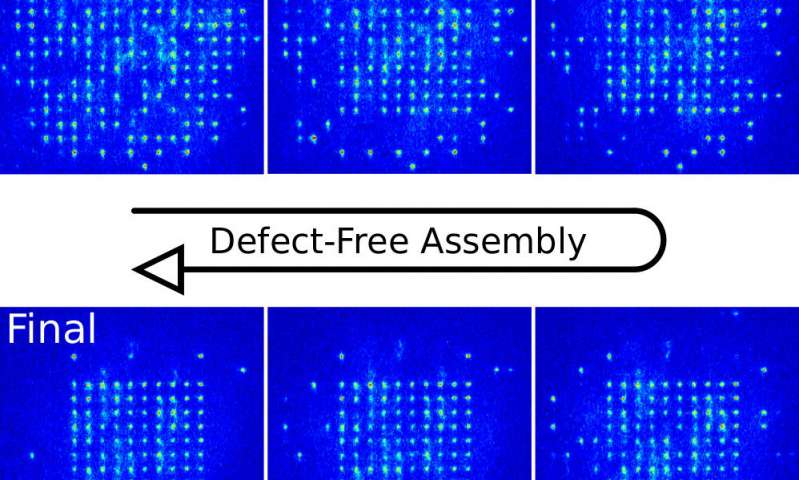
Researchers at Technische Universität Darmstadt have recently demonstrated the defect-free assembly of versatile target patterns of up to 111 single-atom quantum systems. Their findings, outlined in a paper published in Physical Review Letters, could drive...
The DUNE experiment could lead to new discoveries about solar neutrinos
The Deep Underground Neutrino Experiment (DUNE) is an international research collaboration aimed at exploring topics related to neutrinos and proton decay, which should start collecting data around 2025. In a recent study featured in Physical Review Letters, a team of...
The experimental demonstration of a spin quantum heat engine
The theoretical notion of a 'quantum heat engine' has been around for several decades. It was first introduced around sixty years ago by Scovil and Schulz-DuBois, two physicists at Bell Labs who drew an analogy between three-level masers and thermal machines.
The first direct search for inelastic boosted dark matter with a terrestrial detector
A team of researchers in the Republic of Korea, the U.S., Brazil, Indonesia and the U.K. have recently carried out a direct search for inelastic boosted dark matter (IBDM) using a terrestrial detector. Their study, published in Physical Review Letters (PRL), is the...
Spontaneous magnetization in a non-magnetic interacting metal
Over the past decade, numerous physics studies have explored how oscillating electric fields produced by lasers or microwave sources can be used to dynamically alter the properties of materials on demand. In a new study featured in Nature Physics, two researchers at...
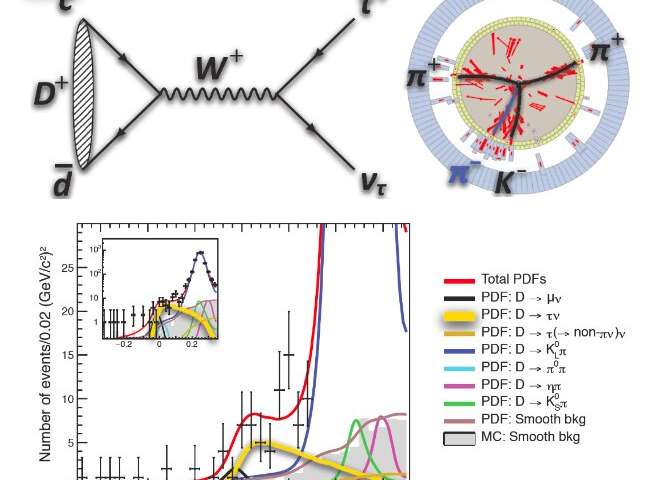
Study gathers the first observation of leptonic decay D+→τ+ντ
The Beijing Spectrometer III (BESIII) collaboration, a large team of researchers from universities worldwide conducting particle physics studies has recently reported the first observation of the leptonic decay D+→τ+ντ. This observation, presented in a paper published...
Studying a cell’s crawling motion in a fluid
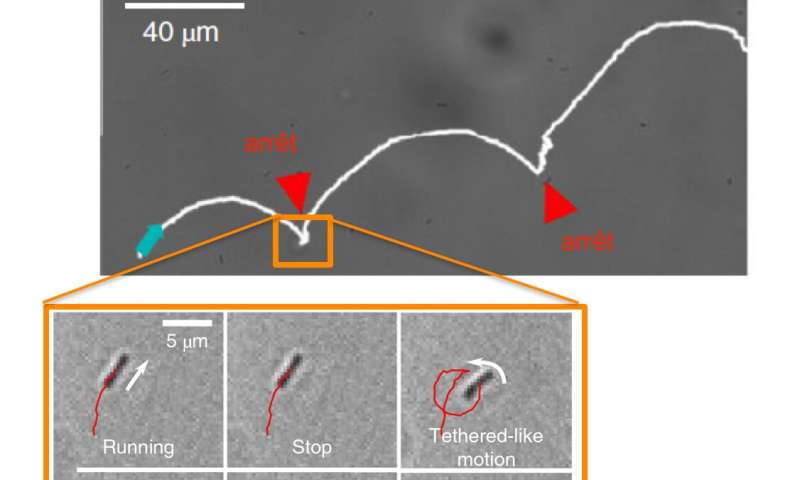
Cell motility, the spontaneous movement of cells from one location to another, plays a fundamental role in many biological processes, including immune responses and metastasis. Recent physics studies have gathered new evidence suggesting that mammalian cells do not...
Studying chiral exchange drag and chirality oscillations in synthetic antiferromagnets
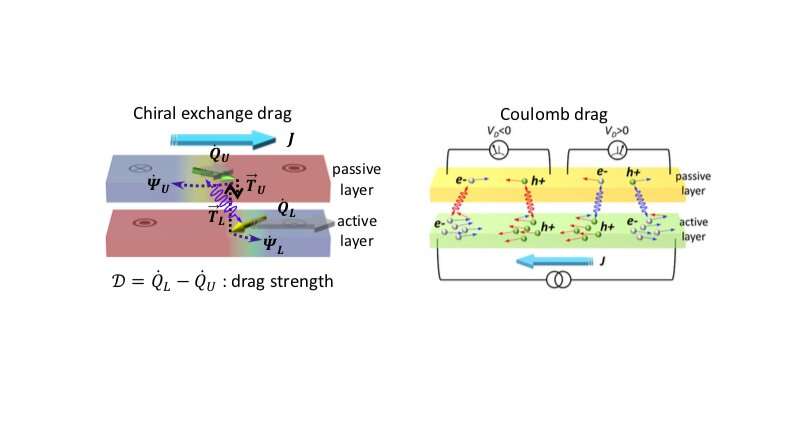
A quasiparticle is a disturbance or excitation (e.g. spin waves, bubbles, etc.) that behaves as a particle and could therefore be regarded as one. Long-range interactions between quasiparticles can give rise to a 'drag,' which affects the fundamental properties of...