Researchers at IBM have recently devised a new technique to virtually patch security vulnerabilities before they are found. Their approach, presented at the International Workshop on Information and Operational Technology, co-located with RAID18, leverages testing...
TECHXPLORE
Distilled 3-D (D3D) networks for video action recognition
A team of researchers at Google, the University of Michigan and Princeton University have recently developed a new method for video action recognition. Video action recognition entails identifying particular actions performed in video footage, such as opening a door,...
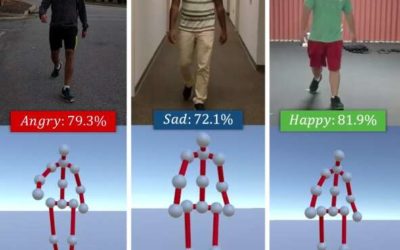
Identifying perceived emotions from people’s walking style
A team of researchers at the University of North Carolina at Chapel Hill and the University of Maryland at College Park has recently developed a new deep learning model that can identify people's emotions based on their walking styles. Their approach, outlined in a...
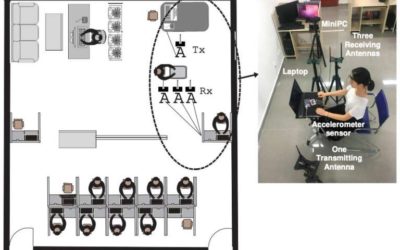
EmoSense: an AI-powered and wireless emotion sensing system
Researchers at Hefei University of Technology in China and various universities in Japan have recently developed a unique emotion sensing system that can recognize people's emotions based on their body gestures. They presented this new AI- powered system, called...
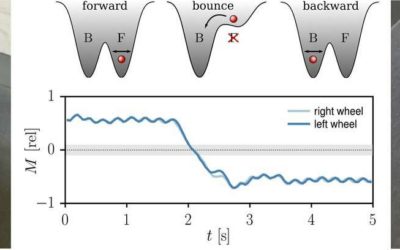
Implementing kick control on simulated and real-world wheeled robots
A team of researchers at Babes-Bolyai University, in Romania, and Goethe University Frankfurt have recently collaborated on a study exploring implementations of kick control on both simulated and real-world wheeled robots. The term 'kick control' refers to short,...
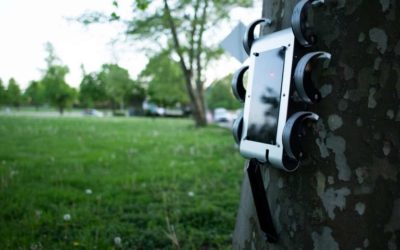
Enhancing the vertical mobility of six-legged robot RHex using microspines
A team of researchers at Carnegie Mellon University has recently proposed a method to improve the vertical mobility of a renowned hexapod robot. Their approach, presented in a paper pre-published on arXiv, entails the addition of microspines to RHex, an existing...
Inflatable space robots with integrated dielectric elastomer transducers (DETs)
Researchers at the Auckland Bioengineering Institute and Technische Universität Dresden have recently designed a new type of inflatable robot for space navigation. These robots, presented in a paper published in SPIE Digital Library, were created using dielectric...
Estimating people’s age using convolutional neural networks
Over the past few years, researchers have created a growing number of machine learning (ML)-based face recognition techniques, which could have numerous interesting applications, for instance, enhancing surveillance monitoring, security control, and potentially even...
Evaluating robots as teachers or partners in language learning exercises
Researchers at the Royal Institute of Technology (KTH) in Sweden have carried out a study exploring the effects of using physical robots to assist humans during vocabulary learning exercises. The department of Speech, Music and Hearing at KTH specializes in...
ExAG: An image-guessing game to evaluate the helpfulness of machine explanations
In recent years, researchers have been trying to make artificial intelligence (AI) more transparent by developing algorithms that can explain their actions and behavior, as this could encourage greater trust in machines and enhance human-AI interactions. Despite their...