Researchers at the University of Tartu's Computational Neuroscience Lab, in Estonia, have discovered that activations of deep convolutional neural networks are aligned with the gamma band activity of the human visual cortex. Their study, published in Communications...
TECHXPLORE
New real-time localization and mapping tools for robotics, VR, and AR
A large group of researchers at Imperial College London, the University of Edinburgh, the University of Manchester, and Stanford University have recently collaborated on a project exploring the application of real-time localization and mapping tools for robotics,...
Object detection in 4K and 8K video using GPUs
Researchers at Carnegie Mellon University have recently developed a new model that enables fast and accurate object detection in high-resolution 4K and 8K video footage using GPUs. Their attention pipeline method carries out a two-stage evaluation of every image or...
Optimal resource allocation for UAV communication systems in disaster management
Researchers at Queen's University Belfast (QUB) and Duy Tan University (DTU) have been collaborating on a project aimed at improving the communication systems of unmanned aerial vehicles (UAV). Their research was awarded the Newton Prize 2017, receiving £200,000 by...
Emotion recognition based on paralinguistic information
Researchers at the University of Texas at Arlington have recently explored the use of machine learning for emotion recognition based solely on paralinguistic information. Paralinguistics are aspects of spoken communication that do not involve words, such as pitch,...
End-to-end learning of co-speech gesture generation for humanoid robots
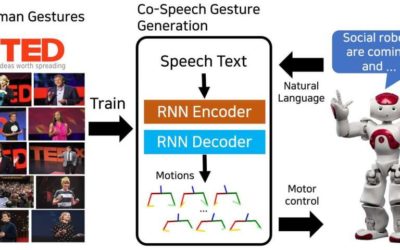
Researchers at the Electronics and Telecommunications Research Institute (ETRI) in South Korea have recently developed a neural network model that can generate sequences of co-speech gestures. Their model, trained on 52 hours of TED talks, successfully produced...
Evaluating creativity in computational co-creative systems
Computer programs assist humans in a variety of ways, including in their creative endeavors. Researchers at UNC Charlotte and the University of Sydney have recently developed a new framework for evaluating creativity in co-creative systems in which humans and...
Developing brain atlas using deep learning algorithms
A team of researchers from the Brain Research Institute of the University of Zurich and the Swiss Federal Institute of Technology (ETH) have developed a fully automated brain registration method that could be used to segment brain regions of interest in mice.
Evaluating linear and rotational microhydraulic actuators driven by electrowetting
Microhydraulic actuators are designed to convert electrical power into mechanical power on a microscale with more power density and higher efficiency. Essentially, these new actuators work by combining the surface tension force derived from a large number of droplets...
BrambleBee: An autonomous robot to pollinate bramble plants
Natural pollinators, particularly honey bees, are disappearing at an unprecedented rate. This poses serious risks for agriculture, the economy, and the sustenance of humans and animals. Bees are the primary pollinators of a vast variety of crops, so their...